
Fields Inside Elk County Property Tax Records
Elk County property tax records are divided among offices because value setting, tax-roll preparation, and collection are separate jobs. The Elk County Appraiser establishes classification and value as of January 1. The County Clerk prepares the tax roll, maintains tax-unit maps, and applies levies. The Elk County Treasurer bills, collects, and distributes ad valorem taxes and special assessments.
| Tax-record field | Question it answers | Official keeper |
|---|---|---|
| Appraised or market value | What estimate was set for the January 1 valuation date? | Appraiser |
| Classification and assessed value | Which statutory ratio was applied to the appraised value? | Appraiser |
| Taxing unit and levy | Which local levies apply to this parcel? | County Clerk |
| Special assessment | Was a separate local charge added? | Clerk and Treasurer |
| Statement and payment | What was billed, received, or still due? | Treasurer |
Keep those labels straight. Appraised value is not the taxed amount, and assessed value is not a sale price. A payment receipt proves nothing about ownership. When figures from two offices clash, the parcel identifier and tax year settle which record controls.
Follow the Elk County Tax Statement Trail
The state payment page only takes payments. It is not a public tax-roll search for Elk County parcels. Find the parcel in ORKA first. Then ask the right county office for the underlying record, so a payment screen never passes for a complete history.
- Use the Kansas ORKA map to locate the parcel by address, owner name, Quick Ref ID, Parcel ID, or PLSS description.
- Save the 19-digit, zero-padded PID, legal description, and taxing unit shown in the parcel summary.
- Ask the Appraiser for the parcel card and valuation year, then ask the Clerk for tax-roll and levy detail if needed.
- Contact the Treasurer for the statement, receipt, installment status, special assessment, or delinquency record.
- Use the Kansas Property Tax Payment portal only when ready to select Elk County and make or verify a payment transaction.
Online tools are only one channel. Treasurer records also open at the courthouse counter. Mail works as well, and the office drop box accepts items around the clock. A narrow Kansas Open Records Act request can seek an existing parcel card, tax record, or levy record the public web route does not display. Name the parcel and tax year in the request. Note: Ask for the tax year, parcel ID, and a fee estimate before requesting many pages from more than one Elk County office.
Read Elk County Property Tax Terms Precisely
Many numbers can sit beside one Elk County parcel. Their names describe how each figure was produced and what it can support. Equally appraised parcels can still carry different assessed values, because Kansas applies classification ratios.
- Appraised or market value
- The Appraiser's estimate of fair market value as of January 1, except agricultural land follows Agricultural Use Value rules.
- Assessed value
- The appraised value multiplied by the constitutional or statutory ratio for the property class.
- Levy
- The rate applied to assessed value to fund taxing units; special assessments can appear separately.
- Tax lien
- A claim tied to unpaid property tax. A delinquent list or notice is not itself a deed.
Kansas classes drive the math. Residential real property is assessed at 11.5 percent. Agricultural land uses 30 percent of its use value. Commercial and industrial property uses 25 percent, vacant lots and certain not-for-profit property 12 percent, public utility property 33 percent, and other real property 30 percent. Classification matters as much as the top-line appraisal.
Paying an Elk County Property Tax Statement
The Treasurer accepts payments through the channels listed on the county page. The state portal does not expose the county's full public tax roll. In-person and mail routes still matter for that reason. The courthouse drop box runs 24 hours a day. Counter service follows county hours. Card payments carry a 2.5 percent fee. Before paying, match the statement to the PID, legal description, tax year, and owner name as shown for tax purposes. A figure may include a special assessment. Keep it apart from the ordinary ad valorem levy when comparing years. The state payment screen shows the county-selection and statement workflow for online transactions. That is its whole job.
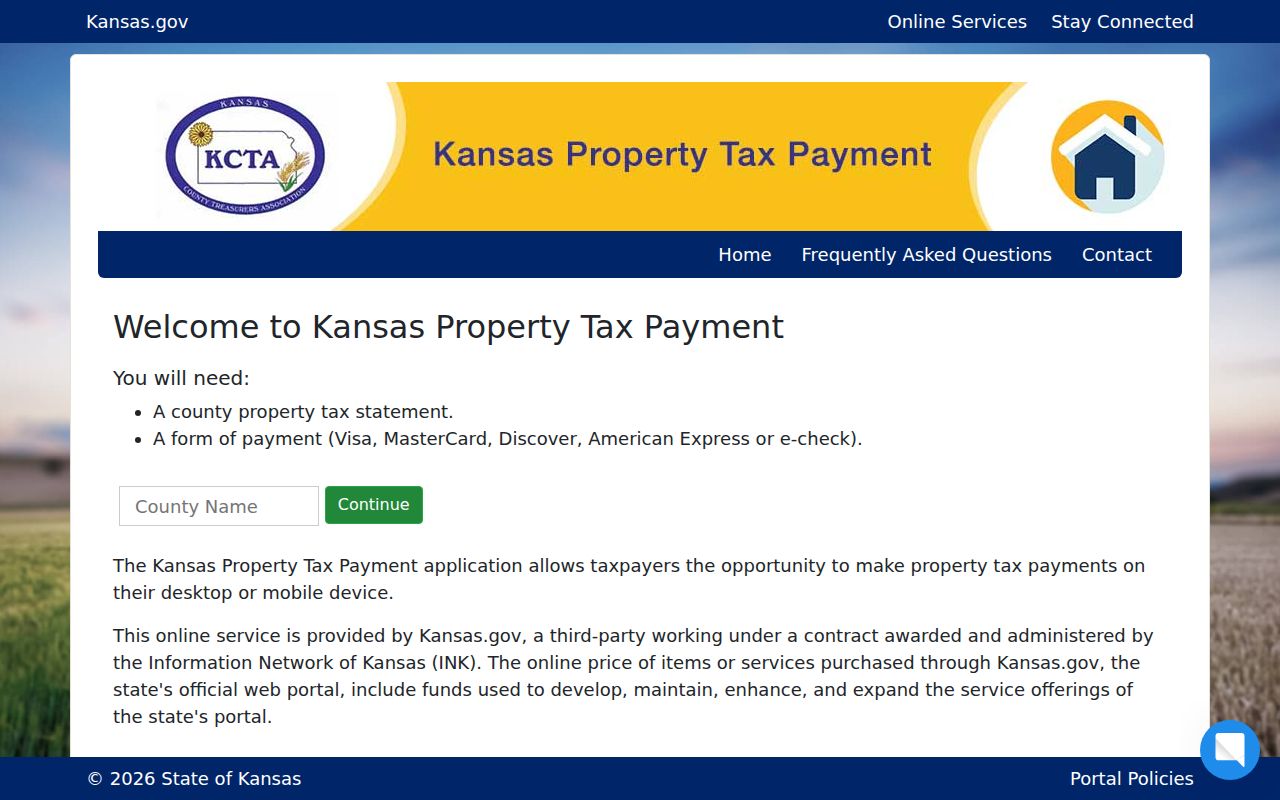
The state screen starts with county selection. Choosing Elk County produces a payment workflow, not a searchable public history for every parcel.
Challenge an Elk County Property Tax Value on Time
Kansas mails real-property valuation notices by March 1 under the state calendar. A 30-day window follows the notice. It covers the request for an informal meeting, which occurs by May 15. The Appraiser's final determination comes by May 20. A Board of Tax Appeals filing is generally due within 30 days of that decision. Current-year instructions control. A strong file preserves the notice, envelope, PID, legal description, class, appraised and assessed values, photographs, condition facts, and the written determination. Comparable sales or cost or income evidence helps. Agricultural land needs use-value and soil context rather than a residential-sales comparison.
Protect the deadline. Contact the Elk County Appraiser as soon as the notice arrives and verify the current tax year's informal-meeting and BOTA dates before relying on a calendar summary.
Two appeal routes exist in Kansas. The Kansas Department of Revenue appeal guidance separates an equalization appeal from payment under protest. The routes do not stack. A taxpayer who used the valuation-appeal route cannot use payment under protest for the same issue and tax year.
Request Elk County Valuation Evidence
ORKA's public summary is not the Appraiser's complete working file. Its Full Report sits behind a verification gate. No parcel-specific value history or comparable-sales grid appears there. Ask the office directly for the parcel card, valuation history, public comparable material, and appeal or inspection notes tied to a PID and year. The Appraiser works from the Elk County Courthouse. The office can be reached at 620-374-2832 or appraiser@elkcountyks.org. Schedules and field-season availability shift, so confirm current counter hours before visiting for parcel cards or historical aerials. The Elk County Appraiser page shows the office's valuation, mapping, 911-addressing, and appeal resources.
That office page is the right starting point for local forms and current contacts. A statewide calendar only goes so far. Note: A missing ORKA detail may reflect the access gate, not the absence of an Elk County valuation record.
Separate Elk County Delinquency, Sale, and Foreclosure
Unpaid taxes give Elk County property records a new meaning. Under K.S.A. 79-2302, the county publishes a July delinquent real-estate list. It shows the owner of record, the recorded description, any available address, and the taxes and charges owed. Publication can precede a September tax sale. Still, a tract on the list may get paid, corrected, postponed, or removed. That can happen before any sale occurs.
| Stage | Record to request | What still needs proof |
|---|---|---|
| Delinquent list | Published entry and Treasurer account | Current balance and current title |
| Auction | Notice, lot status, bid record, certificate | Whether the tract sold or was withdrawn |
| Redemption | Payment and certificate-cancellation record | Effect of the specific payment |
| Judicial foreclosure | Case, judgment, confirmation, recorded deed | The complete transfer chain |
K.S.A. 79-2401a generally allows a two-year redemption period, though exceptions apply. K.S.A. 79-2801 governs the judicial foreclosure that can follow. Those are legal stages, so the Treasurer page by itself cannot show that title passed.
The 2025 Elk County Tax-Sale Record Trail
One county notice scheduled a tax auction for September 16, 2025, at the Cox Building in Howard. Treat that date as a historical example, not current inventory. For any later notice or parcel list, check the live Elk County tax-sale page.
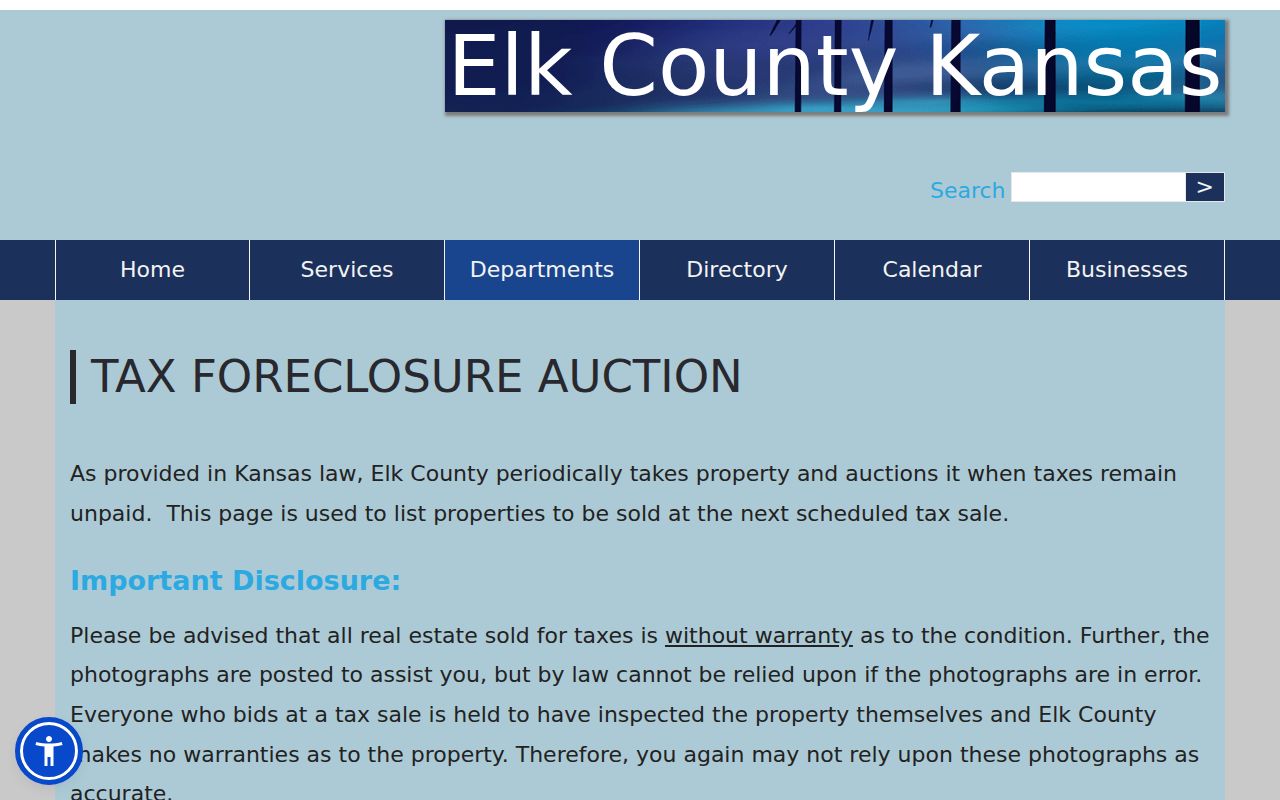
The county cautions bidders directly. Auction property is sold without any condition warranty. Photographs serve only as an aid. Bidders are deemed to have inspected the tract. Those warnings make the sale page a procedural lead rather than proof of condition or ownership.
For a parcel named in a past notice, trace the listed tax description across several Elk County sources. Link it to ORKA, the Treasurer account, the court foreclosure file, and any recorded deed. That keeps a published debt record distinct from a completed conveyance.
Request Elk County Property Tax Records Under KORA
Counter service does not always produce the record you need. Elk County accepts Kansas Open Records Act requests by web form, email, mail, or in person through the Clerk. Ask for an existing record. That could be a parcel card, tax-roll entry, levy sheet, special-assessment record, receipt, or delinquency notice. Include the parcel number, legal description, tax year, and the office you believe holds it.
The county KORA brochure sets the response deadline. It should come as soon as possible. That means no later than three business days after receipt. That clock can yield the record itself. It may instead produce a time estimate, a fee estimate, or a lawful explanation. It does not force the county to fully copy a large request inside three days.
Fees listed in the brochure include $15 per hour of staff time, billed in 30-minute increments. Paper or scanned pages run $0.50 each. Postage also applies, and a $15 minimum is added when electronic data must be supplied in a requested form. Prepayment may be required. Request an estimate first, and narrow the scope before authorizing a large set.
Remember that tax-office access and recorded-instrument access follow different fee schedules. Delinquency may end in a foreclosure deed. Order that instrument through the Register of Deeds. Do not assume the KORA copy price covers a certified recorded copy.