
Build an Elk County Former-Owner Timeline
A timeline is only as good as its entries. Each row should stand for one documented transfer. A shared surname is not evidence. A tax mailing address is not evidence either.
Work backward from the newest deed. Copy the legal description at every step. That description ties the parcel to the file.
Skip nothing in between. Gaps invite guesses, and guesses break the chain.
| Transfer date | Grantor to grantee | Instrument type | Locator |
|---|---|---|---|
| Newest confirmed recording | Prior owner to present grantee | Deed as labeled | Book/page or instrument reference |
| Next earlier recording | Earlier owner to that prior owner | Deed, executor deed, or other conveyance | Office-supplied locator |
| Branch event | Estate, court, or tax parties | Probate, judgment, tax record, or affidavit | Case or volume reference |
| Plat transition | Owner of the larger or changed tract | Plat, replat, split, or vacation | Plat name and page |
Order matters when you sort the paper. A mortgage can look like a sale. So can a lien, an assessment entry, or a newspaper notice.
Those records still have value. They may explain why a transfer happened or who held an interest along the way.
The rule is simple. Every former owner must trace back to the instrument that actually conveyed the stated interest.
Start Elk County Ownership History with the Land
The public Kansas ORKA map links a current address to a Parcel ID. It also provides a boundary description. That description may include an addition, block, lot fraction, section, township, and range. Copy it exactly. Keep the punctuation and the fractions intact.
A fixed-width 19-digit Parcel ID reliably returns you to the same current map record. Still, no official segment decoder exists. No bridge connects the PID to a deed reference. For former-owner work in Elk County, the legal description outlasts the modern address. It is also easier for Register or archive staff to use.
The Register of Deeds offers no self-service online deed index for Elk County. So the backward chain rests on a direct request. Reach the Elk County Register of Deeds by counter, telephone, email, or mail. Include name variants and an approximate date. Add the city or township, the legal-description text, and the record type you need.
Go Back Through Elk County's Deed Parties
The Register of Deeds offers no self-service online deed index for Elk County. So the backward chain rests on a direct request. Reach the Elk County Register of Deeds by counter, telephone, email, or mail. Include name variants, an approximate date, the city or township, the legal-description text, and the record type you need.
- Obtain the newest conveyance and identify its grantee, grantor, recording date, and land description.
- Search the grantor as a grantee in an earlier date window.
- Compare the earlier deed's description with the same tract, accounting for splits and replats.
- Repeat the process until a probate, court, tax, or jurisdiction change requires another source.
- Log negative searches by the actual names, years, indexes, and volumes checked.
- Grantor
- The party that conveyed the stated interest.
- Grantee
- The party that received that interest.
- Reverse index
- An index arranged to find a party in the receiving role, where maintained.
- Chain of title
- The linked sequence of land instruments through time.
- Quitclaim and warranty
- Different forms of conveyance whose exact legal effect must be read from the document.
The Register and Deeds office works from a counter and request model, and its official Register page confirms that starting point for Elk County property records research. The page leaves several practical points unstated. It does not explain how the local deed index is arranged, whether staff can search by legal description, or how search time is charged. Ask all three questions before filing a broad surname request.
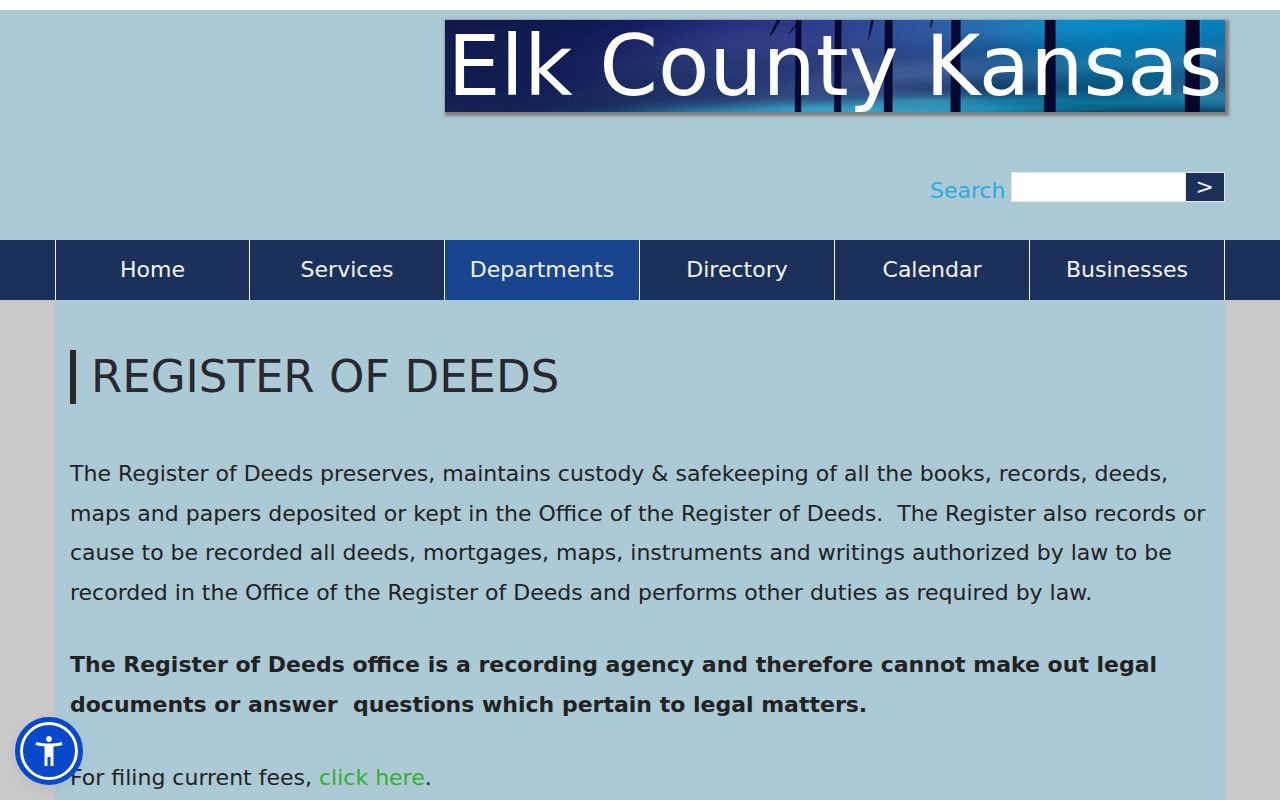
The office's holdings list helps you pick the right record class in the Elk County property records system. The former-owner timeline itself still has to be assembled instrument by instrument, deed by deed.
Repair Elk County Chain Breaks with Probate and Court Files
A deceased owner of record often leaves a messier trail than a routine sale. Probate orders, affidavits, and executor deeds may carry the parcel forward instead. Divorce, foreclosure, quiet-title, condemnation, and tax proceedings can each redirect ownership too. Link each court event to the later instrument in the deed chain. A case-party name alone proves nothing about title. Elk County property records rarely settle that question without the court file.
Elk District Court provides public-file access by appointment when the case number is known. It also maintains a public computer. Kansas CaseSearch can supply case information. However, older or restricted documents may remain only at the courthouse. A portal returning no result simply means no match appeared in that online system.
Note: Court copies and staff research carry separate local charges, so identify the case and request a fee estimate before ordering a large file.
Follow Elk County Lots Through Plats and Splits
Town ownership histories can appear to break for reasons that are not really breaks. A larger parcel was platted, a lot was divided, or a street was vacated. The Register holds city maps, surveys, and plats among Elk County property records. Ask for the plat name and recording date. Also request the page or image reference. Then match the lot-and-block wording to the deed timeline.
In Howard, Moline, and Longton, a block-first search often beats a current street address. Record the addition, block, and lot string in ORKA before contacting the office. For rural parcels, preserve section-township-range terms from the old deed. Ask the Appraiser about 911 address history. Do this whenever modern road labels refuse to match.
How Deep Elk County's Ownership Trail Reaches
Elk County's ownership trail reaches back to 1871. The Register of Deeds first recorded land records that year. Depth does not mean digital depth, though. The county publishes no online grantor-grantee index. So the website offers no cutoff date or parcel-level deed search for visitors to check at home. Older owners of record have to be traced through the office's bound volumes and archive material instead.
The KSHS Elk County collection reaches even deeper, covering 1865 through 2005. It holds deeds and land transfers alongside probate, naturalization, divorce, civil files, vital statistics, and school records. Researchers reach it through the reference room, microfilm, or an archive request. It is not a parcel number lookup.
No online cutoff can be claimed. Elk County lists old land records from 1871, while older and related ownership evidence may require physical volumes, microfilm, or KSHS help.
The Pre-1875 Elk County Title Trap
Elk County was created on March 25, 1875. Before that date, records in this region can sit under Godfrey, Seward, or Howard County. So an old deed, probate entry, or legal notice may be indexed correctly under a jurisdiction that no longer matches the parcel's modern county label. Expect this trap whenever a deed record predates 1875.
Local history adds more wrinkles. The county-seat fight between Elk Falls and Howard included armed removal of records, followed by legal and militia action, and an earlier courthouse burned before the present one rose between 1907 and 1908. None of that proves any particular deed volume vanished. Record the date and the original jurisdiction wording, then ask the archive or the Register which series covers it.
Use Elk County Newspapers as Leads, Not Deeds
The Kansas Newspaper Database lets you search by city, title word, county, and state. You can also set a date range. Old notices can surface sale dates, estate names, tax action, road work, or legal descriptions. Each one is a lead, not proof. Follow it back to the deed, probate file, or court order that settles the question. Kansas residents can borrow microfilm through local-library interlibrary loan.
Watch for early title and place-name variants, too. The Courant, for instance, tied to Longton and Howard County in the 1870s. KSHS flags real uncertainty in the early chronology. Run the city, the county, the title word, and the dates as separate searches. Whatever a notice claims about ownership, confirm it in Elk County property records. Don't rely on it before then.
The archive search page appears below. Its field set is unusually helpful when a former owner vanishes from the deed sequence.
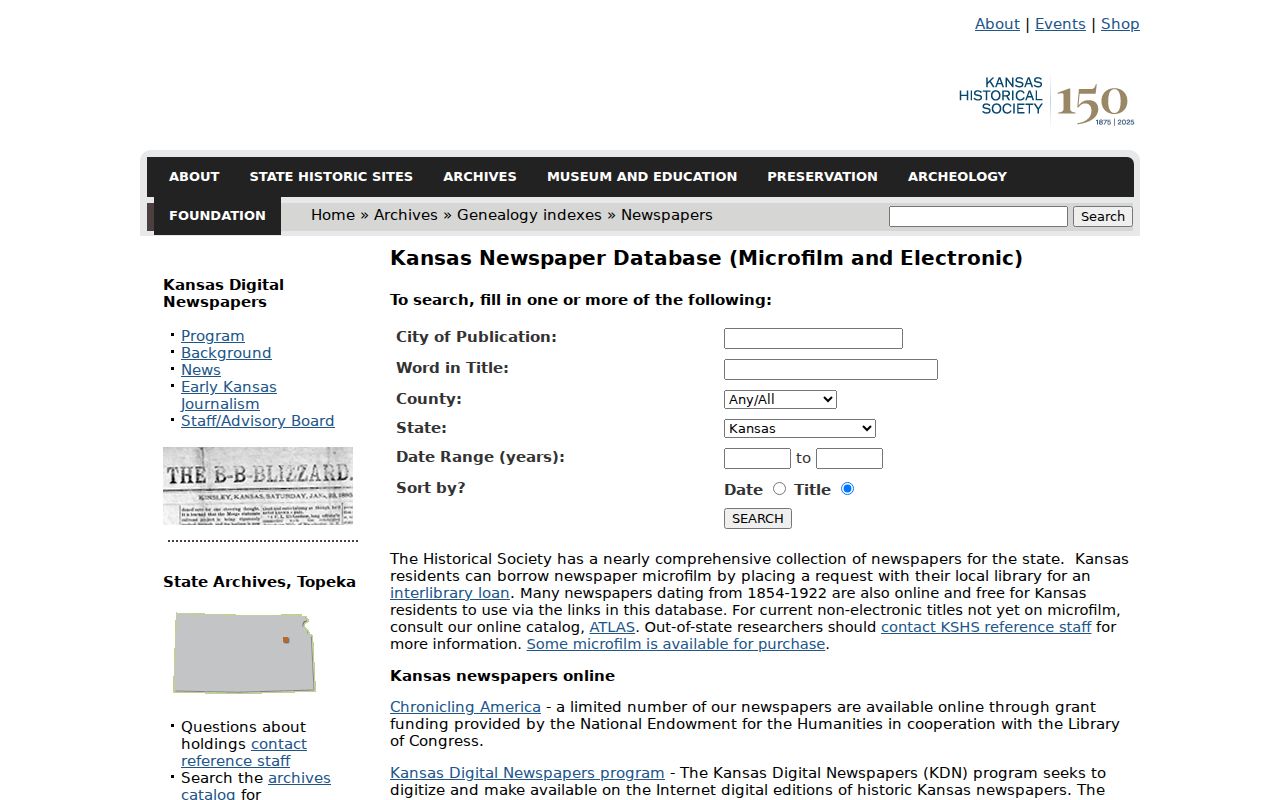
The image shows the statewide discovery route. The document it locates stays a lead until tied to the land and an official transfer record.
Keep Elk County Former-Owner Research Parcel-Focused
Reconstructing past ownership has sound purposes: house history, boundary diligence, estate research, title review. Anchor the work in parcel identifiers, instrument dates, and legal descriptions. Avoid compiling addresses of living people. When an office or archive withholds information, note the restriction rather than working around it.
Historical sequence and current title are different questions. Need the present assessor display? The current-owner record guide is the right tool. A newest-deed check lives there too. The former-owner timeline should stay a sourced history of the tract.
Use records responsibly. Public access never permits tracking, intimidation, stalking, harassment, or harm directed at any living person.
Document Every Elk County Ownership Search
Log every request you make. Record the custodian, the date, and the name form. Record the date range, the index or volume checked, the fee, and the result language. When staff report nothing, ask a clarifying question. Does that mean no match in the named source, or no record known at all? The distinction keeps a thin index from turning into a false endpoint.
Save the legal description beside each instrument image. Note any later splits, vacations, or replats. A clear research log lets someone else reproduce the former-owner chain. It also shows exactly where archive or court work remains.