
What Elk County Deed Records Put on Paper
A conveyance is only one slice of what the Elk County Register of Deeds keeps. The office preserves deeds and every other writing that touches real property. Exact language matters here. One instrument transfers land outright. Another creates, assigns, releases, or merely gives notice of an interest.
| Instrument | What it records | Why to inspect it |
|---|---|---|
| Deed | A stated transfer between grantor and grantee | Build the ownership sequence |
| Mortgage or release | A recorded security instrument or its later release | Follow a financing branch without treating it as ownership |
| Oil and gas lease or assignment | A recorded mineral-related interest or transfer | Trace a rural mineral chain separately from surface title |
| Lien or lis pendens | A recorded claim or notice affecting the land trail | Identify a related tax or court record to inspect |
| Plat or survey | Recorded lot, block, tract, or survey information | Match deed language to the land |
Related filings are not deeds themselves. Mortgages, assignments, liens, lis pendens notices, and releases each get their own index entry in Elk County, because they explain burdens or later events in a land record. A power of attorney can account for a signature. It still does not convey the property.
Elk County's Register Holds More Than Deeds
The official holdings run deep for both rural tracts and town lots. The Register keeps mortgages, federal and state tax liens, oil and gas leases, and assignments. UCC filings, powers of attorney, and cemetery records round out the shelf. Maps, plats, and surveys are held there too. On a rural parcel, a mineral lease or release may cover only a mineral interest. It may also stop at a stated depth rather than full ownership. For a town lot, the plat and survey files are often the best bridge from a modern address back to older deed records.
Historic material adds another layer. The office also holds old land and genealogy records, city and survey maps, and several classes of early county documents. Access limits and formats vary by record class. Ask for a specific record type rather than everything tied to a surname.
The official Register page carries the instrument list and the public contact route. It also posts the office's general-copy statement.
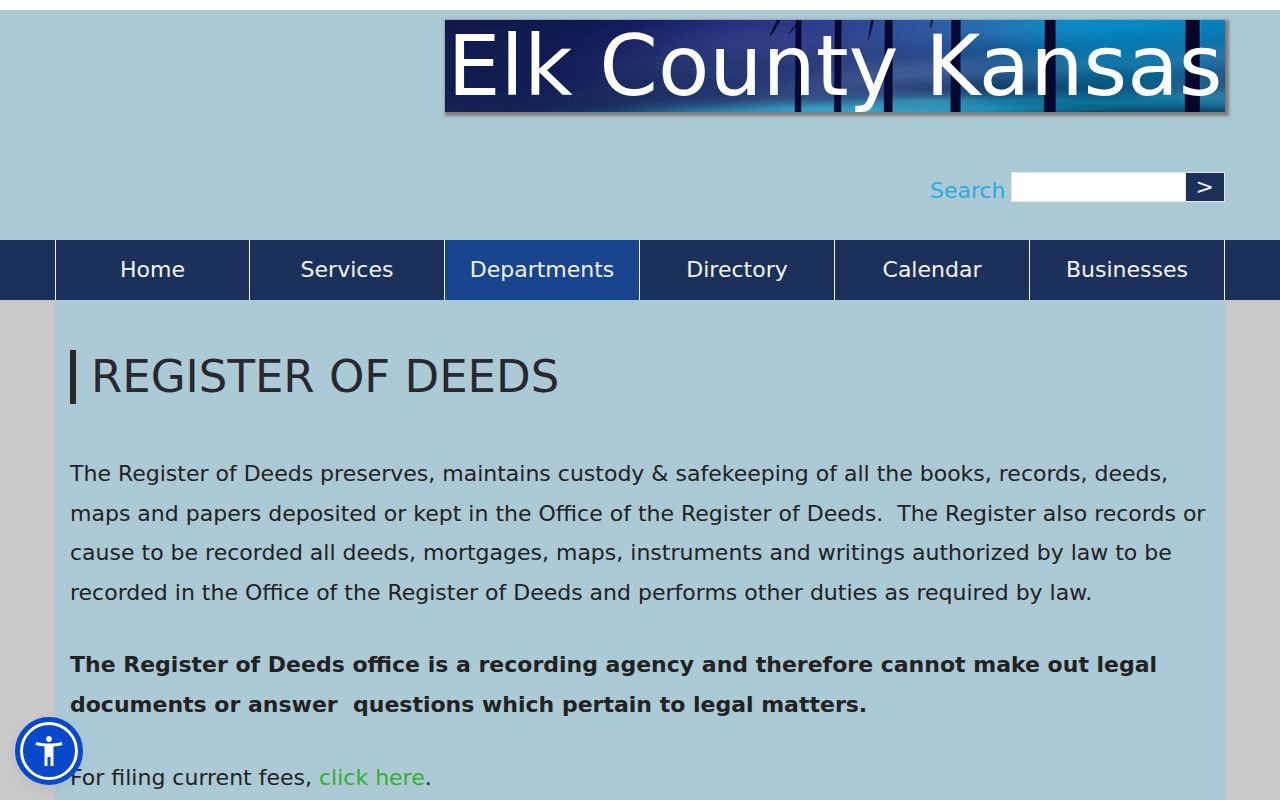
That page draws one line clearly. Staff preserve and provide records, but they cannot draft legal documents or answer legal questions.
Build an Elk County Deed Search Request
Elk County publishes no online grantor-grantee index. So access starts at the counter or through a narrow phone, email, or mail request. The Register sits on the first floor of the courthouse. The courthouse is at 127 N Pine in Howard. Mailed requests go to PO Box 476, Howard, KS 67349-0476. Call 620-374-2472 or email register@elkcountyks.org.
| Request detail | How it narrows the search |
|---|---|
| Grantor and grantee variants | Catches spelling, initials, and entity suffix changes |
| Approximate recording date | Limits the volumes or index period staff must inspect |
| City, township, or PLSS | Separates same-name parties and rural tracts |
| Legal description | Connects the request to addition, block, lot, or section land |
| Instrument type | Distinguishes deed, mortgage, release, lien, plat, or lease |
| Copy choice | Tells staff whether a plain scan or certification is needed |
Ask whether staff can search by legal description and how the local index is arranged. The county publishes no such arrangement. It lists no online image workflow, no turnaround time, and no separate staff-search fee. Put those questions directly to the office before mailing anything.
Note: A Parcel ID helps locate land in ORKA. The county does not say it maps straight to a deed book or instrument number.
Follow Elk County's Grantor-Grantee Trail
You rebuild a chain from the parties and legal description on each instrument itself. Keep an evidence log. Log the recording date, execution date, deed type, parties, legal description, and the book/page or instrument reference the Register returns.
- Use ORKA or a known document to establish the present legal description and current candidate owner.
- Ask the Register for that owner's acquiring deed, searching the person or entity as grantee.
- Read the grantor and the exact land description from that deed.
- Search that grantor as a grantee in an earlier period, then repeat while the description still matches.
- Branch into probate, court, tax-sale, or plat records when the next conveyance is not a simple deed.
- Grantor
- The party that transferred the stated interest.
- Grantee
- The party that received the stated interest.
- Chain of title
- The ordered series of instruments affecting the same land.
- Book/page or instrument reference
- The office locator that identifies a recorded document.
For tracing ownership backward through the historic record, the separate former-owner guide carries that method forward. This deed page stays focused on instrument scope and access.
Recording and Copy Costs in Elk County
The Register's fee schedule splits recording fees from copy prices. Deeds, mortgages, and similar instruments run $21 for the first page. Each added page costs $17. Mortgage assignments and releases cost $20 for the first page and $4 per added page. A town plat runs $32 per page.
Copies are a different line item. The general office page puts routine copies at $0.75 per page. A certified copy adds $7.50. Specialized UCC and tax-lien items carry their own rates. Confirm which fee applies before sending money. This matters when one request mixes a deed, a plat, and certification.
The published fee schedule is the official source for every figure above.
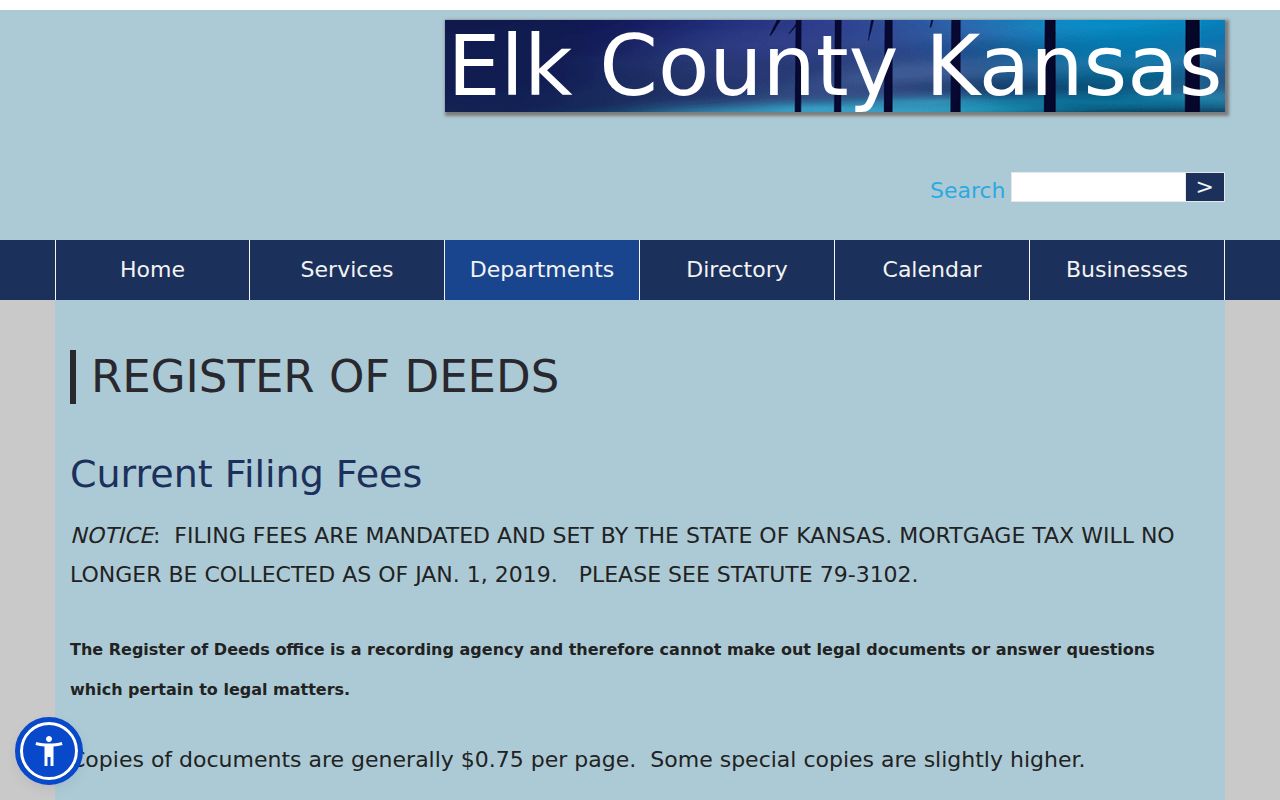
Totals depend on page count and document class. An email request should ask first for the total, payment method, postage, and any search charge.
Read Elk County Encumbrances as Separate Events
Careful deed review keeps every recorded item separate. A mortgage shows a recorded security interest, not that a balance is still owed. Watch for a release or a later assignment. A tax-lien notice does not prove a foreclosure ended in a sale. The notice, foreclosure case, and redemption record are distinct steps. So are the auction record and the deed in Elk County records.
Oil and gas filings deserve the same discipline. Record the tract, parties, term, and any depth or formation language. Then track later assignments or releases. A UCC filing usually covers personal-property collateral. It is no substitute for a land mortgage.
Recorded is not guaranteed. The index reports documents accepted for recording; it is not a title opinion and cannot rule out unrecorded interests or legal defects.
Elk County Deed Records Before the Modern Courthouse
Elk County was not always Elk County. It was created in 1875, yet its listed old land records reach back to 1871. That gap is worth remembering. Early deeds may sit under a different jurisdiction. Godfrey, Seward, and Howard County labels all appear in the region's past, so a careful Elk County property search keeps those predecessor names in play.
The Kansas Historical Society Elk County collection spans 1865 through 2005. Deeds and land transfers sit alongside probate, divorce, and civil material. No parcel-level online index exists. Requests work best with a name, township or town, an approximate date, a record type, and the present legal description as a bridge.
Local history explains some of the digging. The county-seat dispute between Elk Falls and Howard once included armed removal of records. The earlier courthouse later burned. The present building went up from 1907 to 1908. None of this proves a particular deed is missing. It does explain why physical volumes, archive collections, court files, and historic place names can all matter to Elk County property records.
Obtain the Right Elk County Deed Copy
Tell the office exactly what you need. A remote request should say whether a readable digital scan suffices or a certified paper copy is required. Include return contact information. Add alternate name spellings, the date range, the land description, and the desired instrument. Email first when staff must identify the document. The county publishes no self-service deed images. It offers no online payment for this task either.
A "no match" answer deserves a follow-up. Ask which name, period, index, and volume were searched. "No record located in that search" is more precise than claiming no deed exists. For an administrative parcel card or another existing county file outside the Register's usual instrument work, the Elk County KORA route allows written, email, mail, or in-person requests through the Clerk and calls for a fee estimate and prepayment.
Note: Save the returned index metadata with the image; an unlabeled scan is hard to place in the Elk County deed chain later.
Audit an Elk County Deed Request Before Relying on It
A complete return should identify the instrument class, the parties, execution and recording dates, page count, legal description, and office locator. Check that metadata against the requested tract. Only then treat the image as responsive. When just one surname matches, look closely. Initials, entity suffixes, and the land description keep same-name parties from blending together.
Tax-sale tracts need more requests. Ask for the delinquent list, notice, court judgment, sale or bid-off record, redemption material, and later deed as separate records. For mineral work, retain every assignment and release. Narrow questions cost less and yield a more defensible record than asking staff to interpret the whole title chain for a parcel.