
Identify an Elk County Property Owner
Start your search at Kansas ORKA for Elk County. Enter the known address or site. Copy the full parcel number, the owner display, the situs, and the legal description. Treat the ORKA owner name as a clue from the valuation roll, not proof. Take that clue to the Register of Deeds. Request the most recent deed tied to the same legal description. The deed names the owner of record. It carries more weight than any assessment listing.
- Search the address in ORKA; if it misses, use Name, Quick Ref ID, Parcel ID, or PLSS.
- Copy the 19-digit PID and every part of the legal description, including addition, block, lot, and fractions.
- Ask the Register for the latest deed and confirm that its grantee and land description match the parcel.
- If an entity is named, use the Kansas Secretary of State business search only to corroborate that exact entity.
ORKA Names Elk County Owners
The ORKA map opens owner, situs address, legal description, property type, status, and taxing unit fields. These fields cover Elk County parcels. Search modes cover Address, Name, Quick Ref ID, Parcel ID, and PLSS. Elk County uses the abbreviation EK. Its Parcel IDs run 19 digits, so preserve any leading zeroes.
The map works best when you start from a known property. It is not a bulk owner list. For deeper detail than the visible parcel summary, ask the Appraiser for a parcel card. Note that an owner field may lag behind the assessment system's last update. It is not a certified title record.
The official ORKA introduction is the source for this owner-finding route.
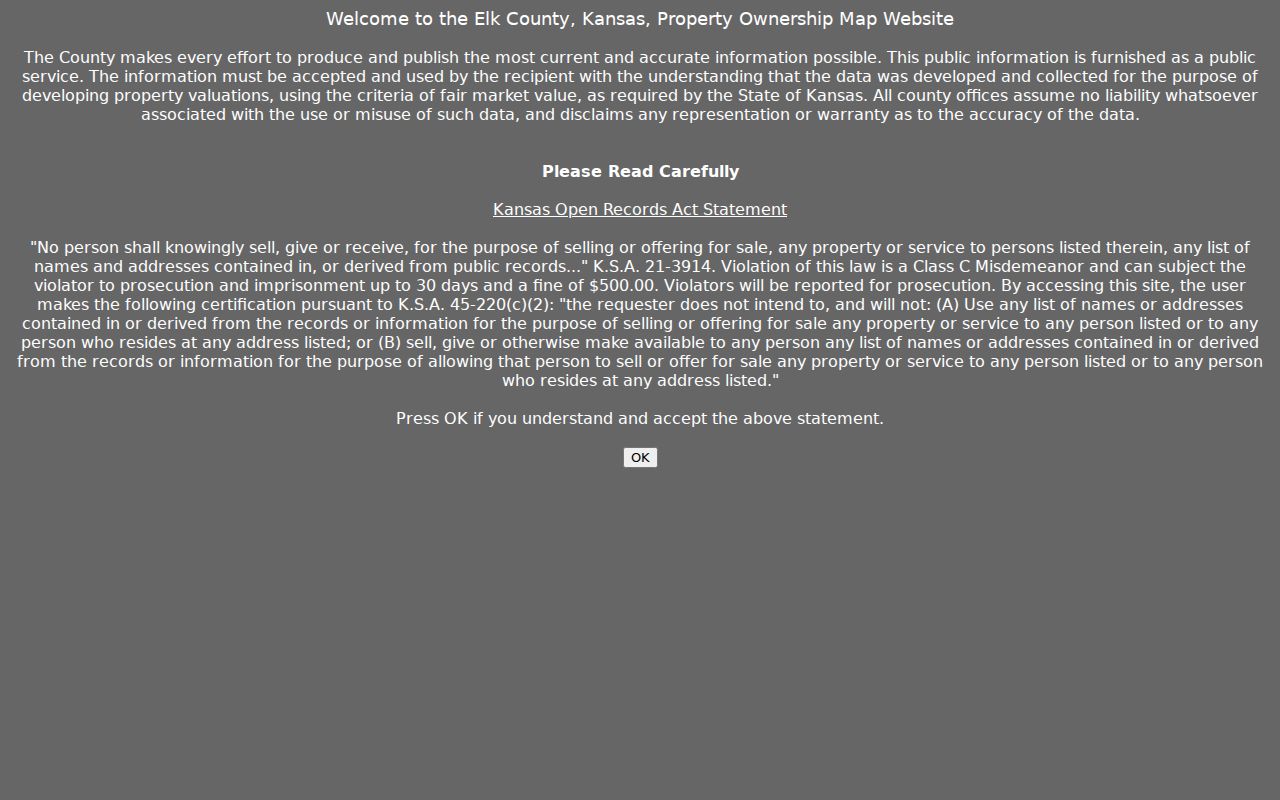
The official ORKA entry names the county map source before any address is traced to its parcel record.
Elk County Ownership Source Trail
No single screen settles who owns an Elk County property. ORKA gives you the mapped parcel plus an assessment owner clue. The Register of Deeds supplies the recorded transfer. Business, probate, or court material then clarifies the name. That step matters when a deed points to an entity, an estate, or a judgment.
| Source | Owner Info It Gives | Access |
|---|---|---|
| ORKA valuation map | Owner display, PID, situs, legal description | Public web map |
| Register of Deeds | Grantee and land in the latest recorded deed | Counter, mail, phone, email |
| Kansas business search | Entity status, registered agent, filings | Public online search |
| Court or probate file | Proceeding that may explain a transfer | CaseSearch or courthouse |
An owner of record is whoever a particular official record names. That person may not live there. Occupants are a different matter entirely. Owner mail can route to another address, and a trust or company may hold the parcel even while a private individual uses the land.
Confirm the Elk County Deed
The Elk County Register of Deeds keeps deeds, mortgages, plats, surveys, liens, and oil and gas leases. It also holds assignments, releases, UCC filings, and powers of attorney. The office publishes no online grantor-grantee index. Reach it by counter, mail, phone, or email. Bring the owner name, legal description, date range, and book and page if you have them.
A grantee is the party receiving the interest a deed describes. Check the grantee in the newest relevant deed. The land text should match the ORKA parcel too. Deeds can reserve an interest. They can convey less than a full parcel or carry archaic legal wording. The Register records papers but neither interprets title nor prepares legal documents.
Copies run $0.75 per page, and certification adds $7.50. Ask which copy you need before ordering.
Entities in Elk County Owner Records
When ORKA or a deed names a company, copy the entity name exactly. Keep the punctuation exactly as shown. The Kansas Secretary of State business search takes an entity name. It also accepts an SOS ID or a resident-agent query. Name searches offer contains and starts-with options. Enter SOS IDs without spaces or dashes.
Results cap at the first 200, so a precise legal name matters. Entity status, agent, and filings can separate two similarly named firms. An agent, though, is not automatically the beneficial owner of the land. Sole proprietorships and assumed names may not appear as SOS entities at all. Return to the recorded deed for the ownership fact.
- Owner of record
- The name carried on a specific official record.
- Grantee
- The party receiving the deeded interest.
- Title
- The legal ownership interest, which a simple lookup cannot fully guarantee.
- Situs
- The parcel's physical address, distinct from owner mail.
Estates and Elk County Transfers
A deceased owner's name can break a simple address-to-name match. So can a probate estate, survivorship wording, a divorce order, or a civil judgment. The deed trail sometimes points to a court case. Kansas CaseSearch and the 13th Judicial District courthouse are branches worth trying at that point. The online portal does not hold every document, sealed matter, or older file.
Kansas State Historical Society holdings for Elk County span 1865 through 2005. They cover land transfers, probate, and civil and divorce files. For older questions, send the county, the name, the township or town, and an approximate date. The source may predate Elk County's formation in 1875. In that case, also test Howard County and earlier jurisdiction terms. Do not assume the owner vanished from the record.
Note: A court caption can explain a transfer, but the recorded instrument remains the land-record confirmation.
Mailing Address Is Not Ownership
ORKA may show a situs while assessment or tax work uses owner mail. The two differ for ordinary reasons. A postal city or ZIP likewise does not prove that a parcel sits inside that city's limits or taxing unit. Compare the PID, legal description, and taxing unit instead of trusting one address line.
For an old rural route or a changed road name, ask the Appraiser about 911-address assignment. Keep historical and current addresses in separate fields. Howard, Moline, and Longton town lots may use original-city or addition, block, and lot language, which stays far more stable than any street address.
Request an Elk Owner Record
Portals do not always show the full property record. Ask the Appraiser for a parcel card. Ask the Register of Deeds for the newest deed copy. Give each office the PID and the complete legal description. Include the owner of record text and a date window. The County Clerk coordinates KORA requests for any county material. The Clerk can route a request to the right custodian.
The county KORA brochure sets the timeline and costs. A response arrives as soon as possible and within three business days after receipt. Fees run $15 per staff hour, billed in 30-minute units. Add $0.50 per paper or scanned page, plus postage. Electronic data-form requests carry a $15 minimum, and prepayment is possible. A focused one-parcel request is easier to estimate. A broad name search through Elk County deed records takes longer to estimate.
Historic Owners Need Place Names
Finding a former Elk County property owner sometimes means chasing older geography. The parcel you start with may not match the place names in the earliest documents. Elk County formed in 1875 from what was earlier Howard County. A deed, probate file, or legal notice from before that split may carry the predecessor county's name. KSHS holdings cover Elk County material from 1865 through 2005, including land transfers and probate files. The older deed records often live there.
Moline adds a second place-name clue. KSHS notes that the Moline post office was established in 1879 after moving from Boston. An early paper may say Boston where a later parcel says Moline. Howard and Longton lots also use original-city, addition, block, and lot wording. Keep those exact labels instead of forcing every source onto a modern street name.
Historic files cannot answer the current owner question alone. They help locate the earlier deed or case file that explains a name change. For who owns the land now, return to the newest ORKA parcel entry and the most recently recorded deed in Elk County property records. Treat the older file as evidence of the chain only.
Limits on Elk County Owner Findings
An owner lookup answers a narrower question than people expect. It can name the assessment owner in Elk County property records. It can also name the latest deed grantee. It cannot prove who occupies the site. It cannot expose a hidden beneficial interest, settle every estate question, or guarantee clear title. A GIS map polygon is not a surveyed line. Bring in a title professional or surveyor when the decision needs that level of proof.
Kansas Safe at Home gives eligible participants address substitution and mail forwarding. Court or law-enforcement protections can limit disclosure. A blank address or a redacted field is not evidence of wrongdoing. Public access to property records does not create a right to target a person.
Lawful use. Elk County owner records are for property research, estate work, boundary questions, and civic review. Never use an owner lookup to stalk, harass, intimidate, or harm anyone.
Keep every lookup tied to the parcel number and legal description. Then verify the date on each owner field before you rely on it.